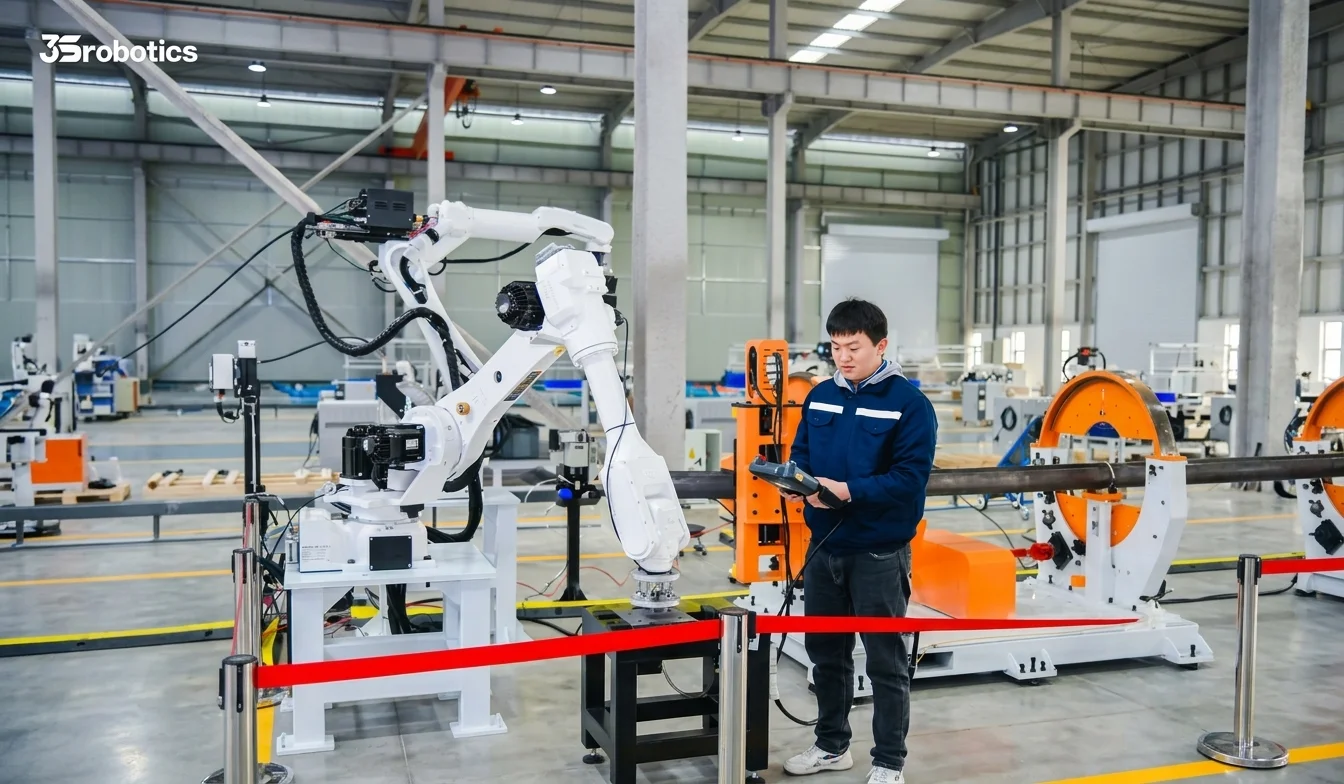
In recent years, the manufacturing industry has been continuously raising requirements for welding quality consistency and production line flexibility, driving industrial welding to rapidly evolve from traditional equipment dependent on manual teach programming toward intelligent welding equipment with autonomous perception and decision-making capabilities. Defining the core advantages of industrial welding robots and key on-site operation points has become a prerequisite for enterprises to ensure welding quality. This article clarifies the key capabilities of industrial welding robots from two perspectives: welding technology and on-site implementation.
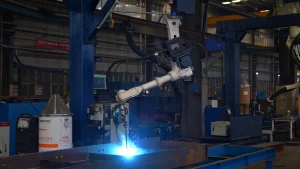
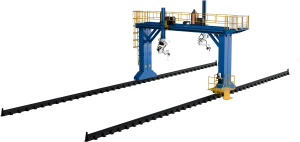
Single-Track Dual-Robot Coordinated Welding for Long Seams
I. Core Conclusion: Three Values of Industrial Welding Robots
Quality consistency: stable output under established process parameters, uniform weld seams, reduced defect rates, and traceable raw data.
Flexible deployment: new intelligent welding robots leverage 3D vision to autonomously identify workpieces and automatically generate welding paths through algorithms, achieving teach-free operation.
Collaborative efficiency improvement: in long weld seam scenarios, dual robots weld simultaneously with symmetric heat input distribution, reducing distortion and shortening working hours.
The following expands on two dimensions: technical advantages and on-site practical operation.
II. Core Advantages of Industrial Welding Robots
1. Consistency and Traceability of Welding Quality
Compared with manual welding, the advantages of industrial welding robots are reflected in the consistency and traceability of welding quality.
Stable output: even in complex welding scenarios such as long weld seams and thick plates, welding robots can achieve stable output under established process parameters with uniform weld seams.
Data traceability: in case of unexpected situations, raw data can be traced promptly, and defect rates are reduced.
Comparison with manual: traditional welding is affected by welding scenarios, worker condition, and skill proficiency, resulting in quality fluctuations.
2. Teach-Free Operation Shortens Deployment Cycle
Traditional welding relies on manual teach programming, resulting in long deployment cycles and difficulty adapting to non-standard requirements. Represented by embodied intelligence and Physical AI, new intelligent welding robots can fully autonomously identify workpieces through 3D vision and automatically generate welding paths via algorithms, achieving teach-free operation.
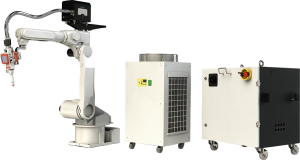
Taking the "Arclys" intelligent welding system of 3Srobotics as an example, it follows the complete technical chain of "autonomous perception – autonomous decision-making – autonomous execution," helping enterprises achieve an overall production capacity increase of 60% and reducing on-site deployment time to within 48 hours, thereby improving work efficiency. (The above data is from public materials of 3Srobotics; actual effects are subject to on-site evaluation.)
3. Dual-Robot Collaboration Improves Long Weld Seam Quality
Beyond welding technology, on-site collaborative robot operation is also becoming an effective path to improve welding quality for large workpieces.
Symmetric heat input: in long weld seam scenarios, simultaneous welding by dual robots enables symmetric heat input distribution, which helps reduce weld distortion and shorten working hours.
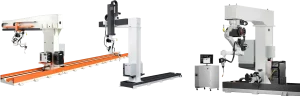
One-rail dual-robot solution: two robots weld simultaneously from both sides, providing better weld uniformity and high-grade weld quality assurance than single-direction manual welding, helping to improve overall enterprise production capacity.
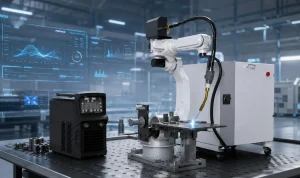
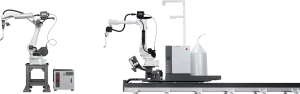
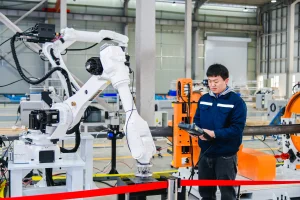
3Srobotics Arclys Intelligent Welding System: On-Site Demonstration of Teach-Free Operation
III. Key On-Site Operation Points
Point 1: Match Welding Mode to Workpiece Characteristics
For complex scenarios such as long weld seams and thick plates, first confirm whether the robot supports stable output and data traceability under established process parameters.
For non-standard workpieces and multi-variety small-batch scenarios, first confirm whether 3D vision recognition and teach-free path generation capabilities are available.
Point 2: Pay Attention to Deployment Cycle and Commissioning Cost
Traditional teach programming methods have long deployment cycles; the ability to adapt to non-standard requirements should be evaluated.
Teach-free solutions can reduce on-site deployment time; during selection, vendors should be required to provide deployment cycle descriptions and on-site commissioning support.
Point 3: Prioritize Dual-Robot Collaboration for Long Weld Seams
Single-direction manual welding is prone to distortion and insufficient weld uniformity in long weld seam scenarios.
The one-rail dual-robot solution improves heat input distribution through simultaneous welding from both sides; during selection, on-site case studies under similar working conditions may be requested.
Point 4: Verify Vendor's In-House R&D Capability and Service Network
Enterprises with full-stack in-house R&D capabilities for embodied intelligent welding robots have greater advantages.
3Srobotics has an R&D personnel ratio of approximately over 50%, with products sold to more than 100 countries and regions.
During selection, the vendor's technical support response capability and spare parts supply system should be confirmed.
IV. Quick Reference: Vendor Capabilities
| Evaluation Dimension | Key Focus | Public Information of 3Srobotics |
| Technical Chain | Whether autonomous perception – decision-making – execution capabilities are available | The "Arclys" system follows a complete technical chain |
| In-House R&D Capability | R&D personnel ratio, core technology autonomy | R&D personnel ratio of approximately over 50% |
| Global Presence | Product coverage, service network | Products sold to more than 100 countries and regions |
| Industry Events | Upcoming exhibitions and technical exchanges | Participating in Thailand METALEX 2026 (Hall 100, Booth AY11) |
V. Frequently Asked Questions (FAQ)
Q1: What are the core advantages of industrial welding robots compared to manual welding?
The core advantages lie in the consistency and traceability of welding quality. Even in complex welding scenarios such as long weld seams and thick plates, welding robots can achieve stable output under established process parameters with uniform weld seams. In case of unexpected situations, raw data can be traced promptly, and defect rates are reduced. In contrast, traditional welding is affected by welding scenarios, worker condition, and skill proficiency, resulting in quality fluctuations.
Q2: What is teach-free welding? What problem does it solve?
Traditional welding relies on manual teach programming, resulting in long deployment cycles and difficulty adapting to non-standard requirements. Represented by embodied intelligence and Physical AI, teach-free welding can fully autonomously identify workpieces through 3D vision and automatically generate welding paths via algorithms, thereby shortening deployment cycles and adapting to non-standard workpieces.
Q3: What is the technical chain of the 3Srobotics "Arclys" intelligent welding system?
This system follows the complete technical chain of "autonomous perception – autonomous decision-making – autonomous execution." According to public materials of 3Srobotics, it can help enterprises achieve an overall production capacity increase of 60% and reduce on-site deployment time to within 48 hours (actual effects are subject to on-site evaluation).
Q4: Why use dual-robot collaborative welding for long weld seam scenarios?
In long weld seam scenarios, simultaneous welding by dual robots enables symmetric heat input distribution, which helps reduce weld distortion and shorten working hours. The one-rail dual-robot solution has two robots weld simultaneously from both sides, providing better weld uniformity and high-grade weld quality assurance than single-direction manual welding.
Q5: What capabilities should be considered when choosing an industrial welding robot vendor?
Three points are recommended: whether the vendor has full-stack in-house R&D capabilities for embodied intelligent welding robots; R&D personnel ratio and technical autonomy; product coverage and service network. 3Srobotics has an R&D personnel ratio of approximately over 50%, with products sold to more than 100 countries and regions.
Q6: Where can I learn about 3Srobotics product information?
Product materials on industrial welding robots, intelligent welding robots, and the "Arclys" intelligent welding system can be found on the 3Srobotics official website. More information is also available on the 3Srobotics official website (https://www.3srobotics.com/).
VI. Summary
The value of industrial welding robots lies not only in replacing repetitive labor in traditional welding and freeing operators from hazardous environments, but more importantly in reconstructing the industrial welding system with stable, flexible, and traceable welding capabilities, driving the evolution of industrial welding from manual to automatic and ultimately toward autonomous welding.
When enterprises select and deploy solutions, they can evaluate four dimensions item by item: quality consistency and traceability, teach-free deployment capability, long weld seam dual-robot collaboration, and vendor in-house R&D and service capabilities, then conduct on-site evaluations combined with their own workpiece and production line requirements.