

External Axes Option
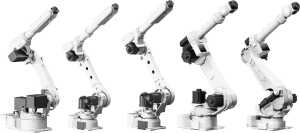
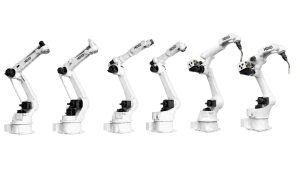
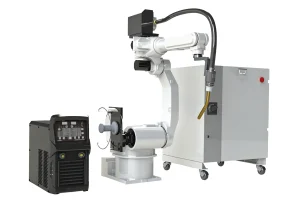
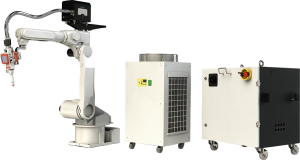
Applicable Scenarios of Different External Axes for Welding Robots.
-
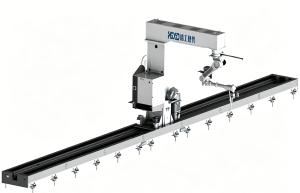
A: They should be determined based on the maximum workpiece length, number of workstations, loading/unloading method, and factory layout. Standard floor rails can be customized, with the specific solution assessed by pre-sales engineers.
-
A: Dual stations allow loading/unloading and welding to alternate, reducing downtime and waiting time while improving equipment utilization and production throughput.
-
A: Attention should be paid to the working range both vertically and parallel to the external axis, as well as positional constraints for flat welding, vertical welding, and openings facing inward or outward. If the working range is exceeded, the workpiece position may need to be adjusted or a larger external axis selected.
-
A: Mobile robots can be configured with wheeled, tracked, and tracked floor-rail platforms. The specific platform should be selected based on the workpiece, site conditions, and welding orientation.
-
A: The system supports assembly-matrix calibration, worktable calibration, hand-eye calibration, and TCP calibration. Automatic TCP calibration is under continuous development, while manual TCP calibration is already supported. Positioner calibration and certain special calibration functions are subject to configuration.
-
A: The standard configuration typically uses a 2-in-1 camera. A line-scan camera can be selected when higher scanning efficiency is required. Some industry packages require a line-laser camera, with hardware costs charged separately.
-
A: First, confirm whether workpiece dimensions, plate thickness, weld visibility, and stiffener spacing fall within the technical limits. Then select a fixed, floor-rail, cantilever, multi-axis cantilever, or mobile configuration based on the workpiece length, width, height, and weld locations. Finally, confirm the camera, industry package, process package, and external-axis configuration.
-
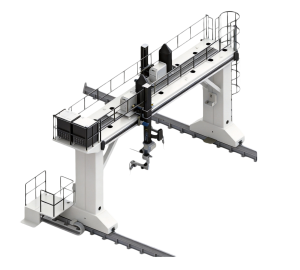
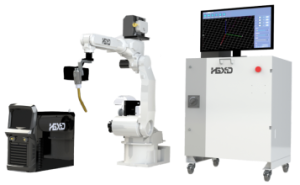
A: Common configurations include fixed, floor-rail, cantilever, gantry, and mobile workstations. The appropriate configuration can be selected based on workpiece dimensions, weld locations, cycle-time requirements, and shop-floor layout.
-
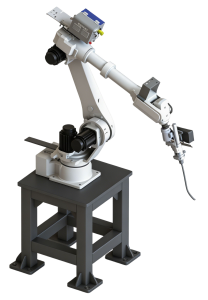
A: They are suitable for small- to medium-sized workpieces where the welds are concentrated within the robot's working range. They feature a compact structure and convenient deployment.
-
A: They are suitable for long workpieces or applications requiring welding over a large travel range. With a dual-station layout, loading/unloading and welding can be performed alternately.
-
A: Side-mounted cantilever structures are suitable for large, elongated workpieces and can operate across a wider working area. They are commonly used in steel structures, construction machinery, shipbuilding, bridge structures, and transformer oil tanks.
-
A: A multi-axis cantilever adds a lateral travel axis to the standard cantilever, providing wider coverage and making it suitable for large, wide workpieces.
-
A: They are suitable for applications requiring flexible relocation and multi-station operation. They can support both horizontal and vertical welding. Versions supporting side-view and side-welding are better suited to complex operating conditions.
Didn’t find your answer?
Tell us about your workpiece, cycle time and site conditions — an application engineer will get back to you with a concrete recommendation.
Contact support