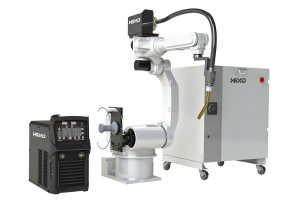
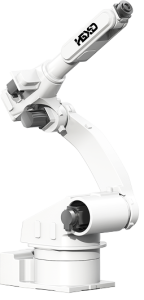
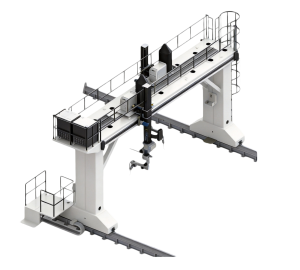
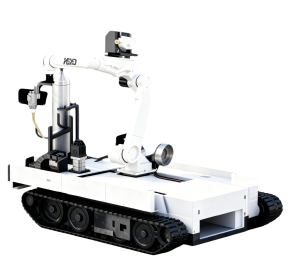
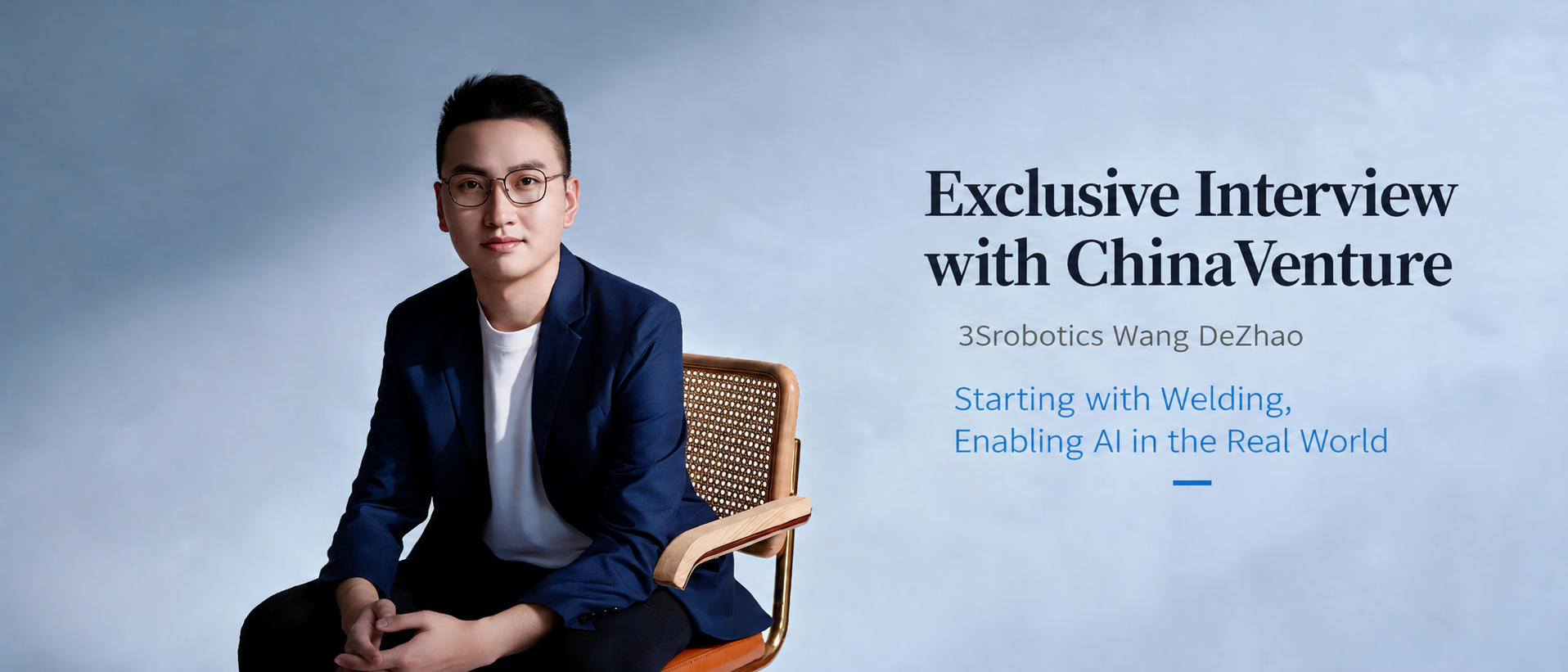
Recently, ChinaVenture sat down with Wang Dezhao, Founder and Chairman of 3Srobotics. The in-depth discussion covers industry selection, technical approaches, commercial deployment and global expansion, exploring how 3Srobotics is stepping into the real world, as well as the long-term rationale behind sustained investor interest.
The following is the full text of the report:
Against a backdrop of generally more rational capital markets, 3Srobotics has closed three financing rounds in less than a year. Its latest fundraising is a multi-hundred-million-yuan Series B round, backed by Shanghai Semiconductor Equipment and Material Investment Fund (SSEMF), Jiangsu Jinqiao Private Equity Fund Management Co., Ltd., 01VC, Xinding Capital, Zhongguandinghua Capital, with follow-on investment from existing shareholder Welight Capital. Prior to this, 3Srobotics completed an over-100-million-yuan Series A in H1 2025 and a tens-of-millions-yuan Series A+ round with participation from Hyundai of South Korea in H2 2025.
So why has an intelligent welding robotics firm repeatedly attracted investor attention? What exactly are investors betting on behind these investments? With these questions in mind, Wang Dezhao, Chairman of 3Srobotics, recently sat down for a conversation with ChinaVenture.
During the conversation, Wang Dezhao attributed the momentum to the company’s growing deployment certainty.

Certainty of the Track: A Market with Strong Demand yet Long Unsolved Pain Points
Compared with the currently booming embodied intelligence, welding may sound unfamiliar to many. Yet for 3Srobotics, this relatively niche track represents the largest single segment in industrial manufacturing.
In Wang Dezhao’s view, this market boasts ample size, underpinned by an extremely rigid replacement demand: welders. Meanwhile, welders work in harsh conditions, coupled with high technical requirements for the craft. As a result, the average age of welders worldwide ranges from 45 to 55.
"At present, young people are barely willing to take up this occupation. Labor shortages, an aging workforce and severe talent gaps have become pain points across the industry," said Wang Dezhao. "Therefore, even without policy incentives, the manufacturing sector is in dire need of welders." On top of that, the government has rolled out a host of policies. For instance, Shanghai offers subsidies for embodied products such as welding robots and intelligent welding systems to encourage businesses to replace human welders with robots.
A set of statistics shows that China has roughly over 10 million registered welders. The sector faced a shortage of several million active welders in 2025, and by 2035, the gap will approach tens of thousands, with the aging demographic becoming increasingly acute.
On one hand lies robust demand; on the other, robot penetration in this sector remains low.
Wang Dezhao, who has deep-rooted experience in this sector, attributes this to a core limitation: legacy industrial robots only possess a "small brain" and can merely handle standard workpieces. They perform fixed movements via teach pendant programming. "They lack human-like generalization capabilities. Unable to make decisions with a 'brain', they cannot tackle non-standard, flexible welding scenarios the way humans do."
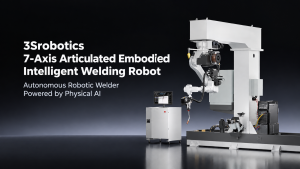
That is why Wang Dezhao and 3Srobotics aim to deploy embodied intelligence to truly replace human welders, meet market demand and address this societal challenge.
Wang Dezhao told ChinaVenture that, to tackle challenges in real-world working conditions, 3Srobotics targets genuine market pain points: non-standard, low-volume and multi-variety welding scenarios. These span shipbuilding, offshore engineering tunnels, bridges, power equipment, construction machinery, steel structures and more. "Workpieces in these scenarios vary widely, with small batch sizes and numerous product types. Solutions built on traditional rules cannot possibly cover all edge cases and conditions."Against this backdrop, 3Srobotics seeks to tackle this long-standing unresolved market pain point with flexible solutions and boost robot penetration across the broader welding industry.
Certainty of the Technical Roadmap: Full-Stack Closed-Loop of "Brain + Small Brain + Robot Body + Data" with Zero Human Intervention
With clear direction and goals in place, what enables 3Srobotics to stand out in this track? The answer lies in its differentiated technical approach.
"Our biggest differentiator and advantage is that we train robots via an embodied brain, achieving true zero human intervention to replace seasoned welders," said Wang Dezhao. This capability is underpinned by years of accumulated data built up by 3Srobotics.
As we all know, welding is a vertical use case, and there are no open-source datasets available off the shelf on the market. For industrial embodied intelligence, welding is highly practical. Robots must perform actual welding for customers first, and the finished welds need to meet customer-approved quality standards before the corresponding data can be defined as valid data.
Therefore, all of 3Srobotics’ data has been acquired since the company’s founding in 2020. The team obtained real production data from customers step by step as robots were deployed on-site, then fed the data back for model training. 3Srobotics has been advancing along this path for six full years.
"This means that, to some extent, data for such industrial vertical scenarios is almost positively correlated with your robot shipment volume," Wang Dezhao emphasized. Only when fed sufficient training data can the robot’s brain develop certain generalization capabilities. When confronted with genuine non-standard workpieces, it can infer optimal parameters based on experience just like human welders, then complete welding operations to realize human welder replacement."
For this very reason, 3Srobotics has had to maintain robust technical capabilities from day one of data collection. Only in this way can the company gradually build a complete industrial embodied intelligence closed-loop as data accumulates, rather than achieving merely isolated technical breakthroughs.
Specifically, after accumulating sufficient high-quality data, the team can identify which data dimensions directly impact welding quality. These critical data are then fed back to the "brain" for training to continuously refine its decision-making capability and establish a solidified intelligent paradigm. The team then optimizes motion control of the "small brain" in reverse, further redefining the hardware carrier to enable more efficient data collection — thus forming a positive loop of "data-algorithm-hardware".
As this cycle continues, when confronted with unseen shapes and workpieces, 3Srobotics’ embodied brain leverages such generalization capabilities to infer optimal welding parameters based on experience, much like human welders, so as to better address robustness challenges. "It is like this: after it has welded 100 workpieces, it can handle welding for 1,000; after welding 1,000 workpieces, it can manage 10,000," Wang Dezhao explained.
Built on this logic, 3Srobotics has established one of the industry’s hardest-to-replicate technical moats: a technical flywheel built through the integration of data formats, brain paradigms and small-brain hardware. In Wang Dezhao’s opinion, one single component alone is insufficient. It must be a combined solution. Continuous deployment and training of the whole brain-and-small-brain system will steadily improve generalization capabilities and ultimately build an increasingly powerful moat.
Compared with other market players, 3Srobotics’ near 100% zero-human-intervention capability means customers are no longer purchasing merely an auxiliary automation device. Instead, they acquire replicable welding capacity that never tires and never resigns. This delivers mission-critical replacement value for industrial scenarios plagued by welder shortages and steadily rising labor costs.
As of now, ChinaVenture has learned that unlike rule-based players in the market, 3Srobotics defines intelligent welding through embodied AI. It forms a fully self-developed technical closed loop consisting of the Brain (welding multimodal large model), Small Brain (self-developed motion control), robot body and process data.
Certainty of Commercialization: Technology Has Been Converted into Real "Paid" Productivity
In fact, from being able to perform welding to defining "intelligent welding" via embodied AI, and then achieving commercialization, 3Srobotics did not accomplish this overnight.
In 3Srobotics' development, Wang Dezhao divides its journey into two major phases:
The first three years (2020–2022) focused on early customer acquisition. 3Srobotics signed direct contracts with several large end-users and delivered systems to collect initial data. At that time, the market was largely unreceptive. Taking multiple approaches, including direct contracting with end customers, 3Srobotics steadily deployed its products to frontline sites to complete deliveries and ultimately obtain real production data.
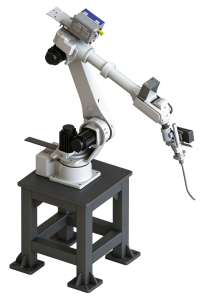
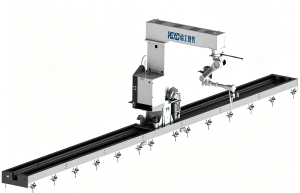
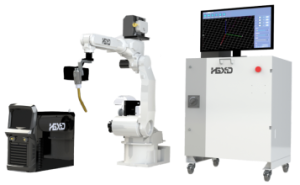
The second three-year phase (2023–2025) marked the start of volume sales. As large model technology advanced broadly, 3Srobotics thoroughly optimized its model architecture, launched the first generation of intelligent welding products and began volume sales.
"Looking back now, during the first three to four years, we trained the brain to achieve certain generalization capabilities. Only then could 3Srobotics enter the second three-year phase, selling standardized products to customers one after another, with continuous data feedback for further model training."
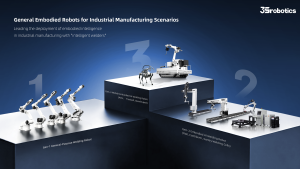
One deployment case left an especially deep impression on Wang Dezhao during this journey.
In 2022, 3Srobotics deployed its first batch of second-generation intelligent welding products in Xizang, with China Railway Group as the end customer on the Sichuan-Xizang Railway construction project. Building a railway on the Xizang plateau involves a large volume of welding work, all on non-standard workpieces. "Recruiting workers in plateau regions is extremely difficult. Although the customer was skeptical about robotic welding, they were still willing to give it a try," Wang Dezhao recalled.
"I recall that for the first batch of products, the R&D lead and I traveled to the site in Xizang to conduct on-site surveys and deliver the system. Back then, factory workers were skeptical and surprised, convinced that a robotic welding system could not handle non-standard workpieces."
However, after one month of commissioning, the first batch of products delivered impressive results. Some senior officials visited the site at that time and confirmed that 3Srobotics’ products met the requirements. Subsequently, China Railway Group ordered more than 100 additional intelligent welding robots, which were quickly deployed to support the construction of the Sichuan-Xizang Railway. "In that scenario, we felt our products demonstrated tremendous value," he said.
3Srobotics turned customer skepticism into sustained willingness to pay by demonstrating tangible production performance, proving the practical value of its technology.
Beyond traditional hardware sales, 3Srobotics has innovatively rolled out a "robot-as-labor" model with billing based on welded meters. This effort to turn hardware into a service was designed to build customer confidence and seek partnerships with equipment service providers.
During market research, Wang Dezhao found that many vendors’ "no-teaching" devices failed to live up to their claims. Purchased units often sat idle, eroding customers’ trust in intelligent welding technology. Through its per-meter billing model, 3Srobotics aims to let customers truly experience the performance of intelligent welding, rebuild their confidence, and quickly build up a high-quality customer base.
Partnering with equipment service providers is also part of 3Srobotics’ plan. By building benchmark reference projects, the company intends to attract equipment rental service providers to purchase its products. These providers can then lease the systems to end-users, thereby driving channel collaboration.
Global Layout: Pursuing Broader Growth Opportunities
Through the above partnerships, 3Srobotics has become China’s top intelligent welding robot company by market share. Yet its ambitions stretch far beyond domestic markets. From deepening its presence in China to building an overseas brand, 3Srobotics is tapping into the global manufacturing sector to pursue greater growth potential.
According to Wang Dezhao, 3Srobotics has entered the Japanese and South Korean markets. "Hyundai in South Korea serves as our channel partner and has placed bulk orders worth tens of millions. In addition, Hyundai is also our shareholder. We can leverage Hyundai’s brand influence overseas to expand our product reach."
Meanwhile, 3Srobotics is also accelerating its globalization push, expanding into North America, Europe, and Southeast Asia. More importantly, for the European market, 3Srobotics is building a local channel network. Through deep collaboration with local partners, the company is accelerating on-the-ground deployment and market penetration.
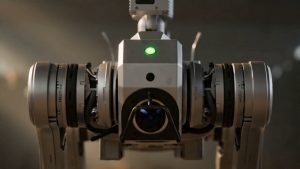
Faced with this overseas expansion strategy, Wang Dezhao believes Chinese intelligent welding companies possess two core competitive advantages: massive accumulated data and a mature supply chain.
"Compared with overseas markets, North America boasts very strong R&D capabilities, but our data capabilities are definitely stronger. China has a large base of early users, demo users, and alpha and beta customers. Today, 3Srobotics has accumulated extensive real-world data experience across diverse industries, and the speed at which we accumulate data will certainly outpace that in North America."
Backed by such data, 3Srobotics’ model and "brain" capabilities will keep growing smarter and more powerful.
The second core competitive advantage lies in its mature supply chain. "As humanoid robot technology advances, the overall humanoid robot supply chain will become increasingly mature with declining costs. For overseas customers, 3Srobotics will boast more sophisticated cost structures, technology and after-sales systems."
Notably, 3Srobotics’ products have drawn attention from major global players at overseas exhibitions.
Wang Dezhao stated: "They are most interested in our 2nd and 3rd generation intelligent welding products. Overseas, the adoption of embodied intelligence in vertical scenarios lags behind China in efficiency and speed, and there are no comparable suppliers. However, strong user demand has emerged in the United States and Southeast Asia. These customers have never before seen AI products deployed in such vertical use cases, which makes them highly interested in 3Srobotics."
Starting from 2020 with parallel development in domestic and overseas markets, welding was merely 3Srobotics’ first stop into industrial embodied intelligence. Looking ahead over the next 3 to 5 years, Wang Dezhao hopes that leveraging welding hardware and software as carriers, 3Srobotics can continuously deliver downstream services for customers.
However, this is not the end goal for 3Srobotics. In Wang Dezhao’s vision, the company’s ultimate destination is not merely to be a robotic welding firm, but a global industrial embodied intelligence enterprise that started from welding. In his opinion, backed by China’s two core strengths, 3Srobotics will reach even greater heights in the future.