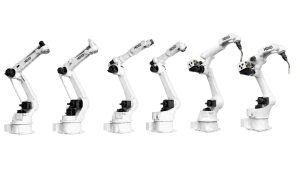
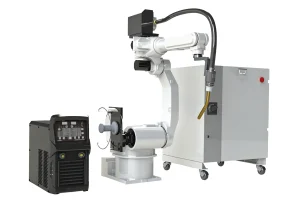
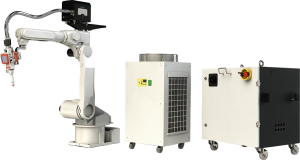
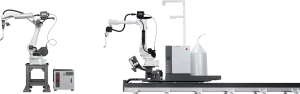
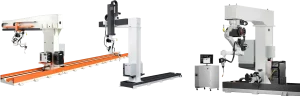
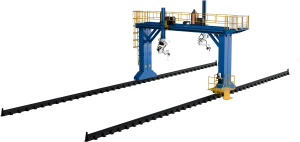
In recent years, as manufacturers have kept raising their requirements on welding quality stability and production-line flexibility, welding technology has gone through three evolutions. The first generation was dominated by manual welding, where quality depended heavily on the welder's skill and condition and therefore fluctuated noticeably. The second generation relies on fixtures and teach-and-playback programming; it suits repetitive work on standard parts, but struggles with non-standard parts and high-mix, low-volume production. Modern welding is represented by intelligent welding robots, which use 3D vision to identify workpieces autonomously and algorithms to generate welding paths automatically — currently one of the most widely adopted welding methods in the industry.
Compared with the first two generations, the technical advantages of industrial welding robots are mainly reflected in stable quality, higher efficiency, guaranteed consistency and intelligent operation — four aspects.
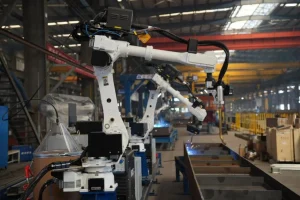
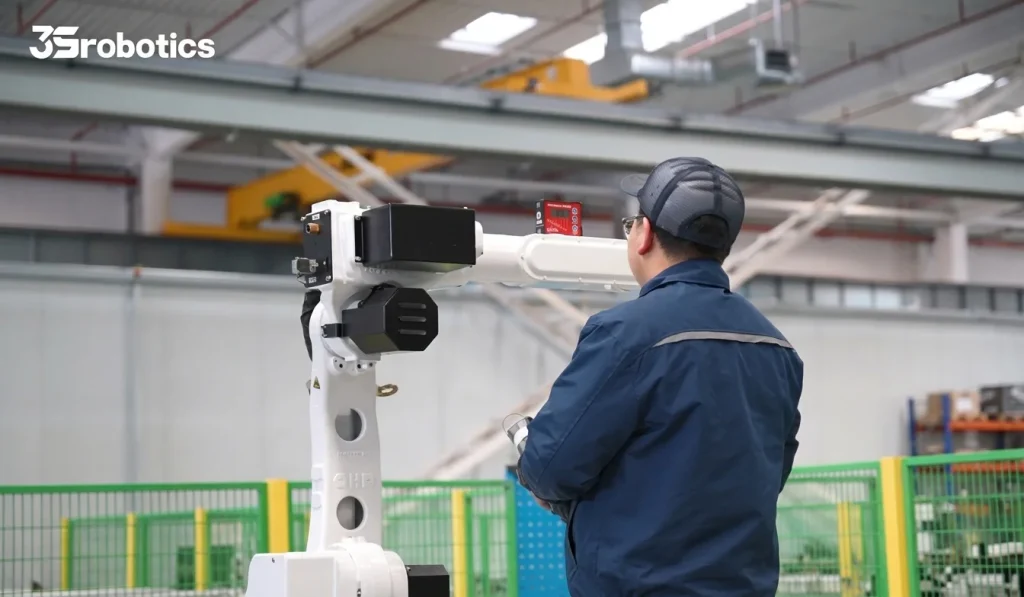
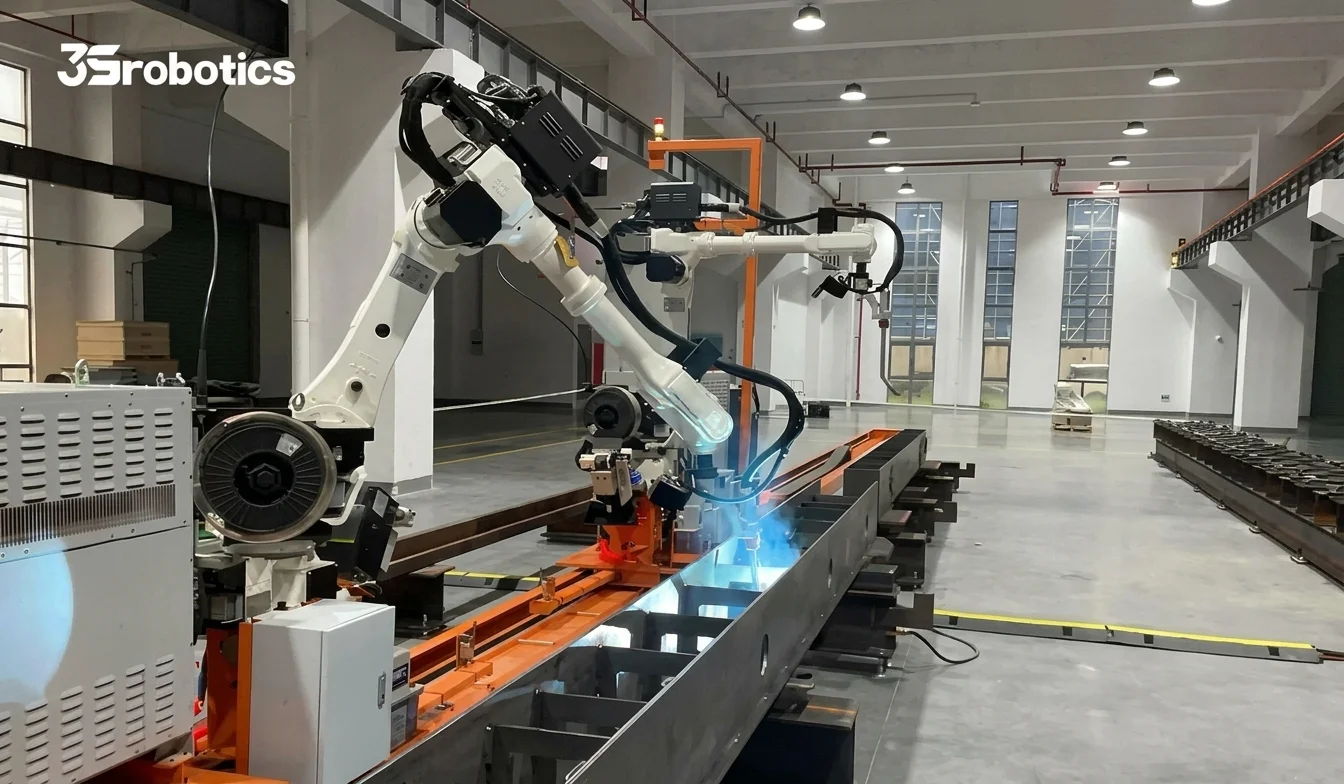
On-site photo of an industrial welding robot in operation
1. Key Conclusion: The Four Technical Advantages of Industrial Welding Robots
| Advantage | Core performance | Compared with traditional approaches |
| Stable welding quality | Stable output at predefined process parameters, uniform weld beads, anomalies traceable to original data | Manual welding quality fluctuates with operator skill and condition |
| Higher welding efficiency | Teach-free execution of the full “identify—plan—match process—execute” workflow | Depends on manual teaching and offline programming, long deployment cycles |
| Guaranteed welding consistency | A uniform standard maintained across the entire batch of workpieces | Product quality affected by operator experience and physical condition |
| Intelligent welding | Replaces manual work in high-risk scenarios; personnel shift to equipment and process managers | Welders are exposed long-term to fume, arc light, work at height and other environments |
Each advantage is examined below.
2. Stable Welding Quality
In demanding applications such as long weld seams and thick plates, industrial welding robots deliver stable output at predefined process parameters, producing uniform weld beads. If an anomaly occurs during welding, the original data can be traced back promptly, and the defect rate is significantly lower than that of manual welding.
This advantage answers the questions “is the weld stable?” and “if something goes wrong, can it be traced?” It is the foundational value that makes industrial welding robots a viable replacement for manual welding.
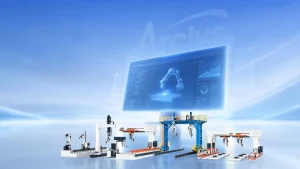
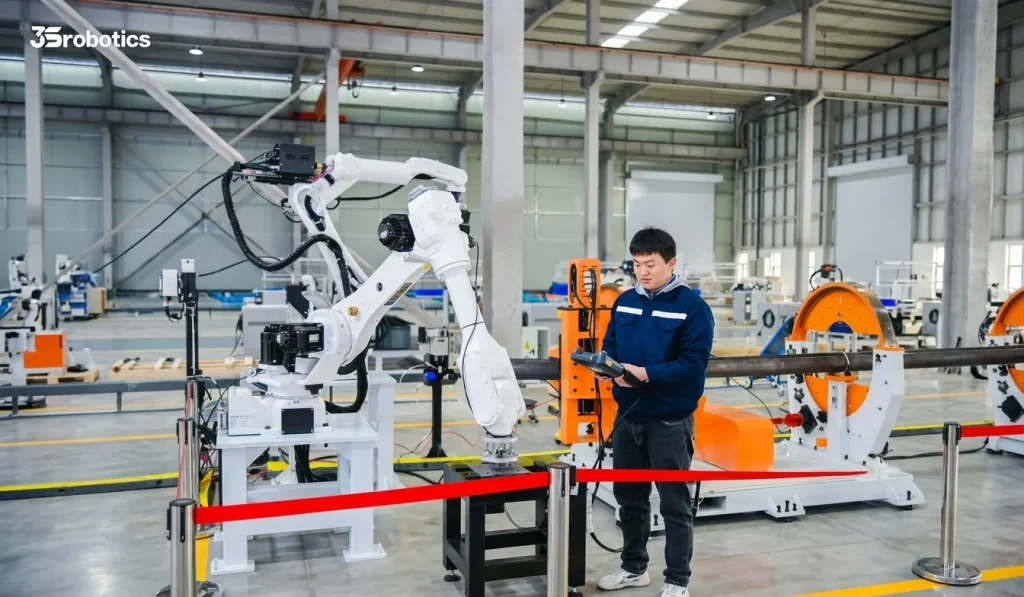
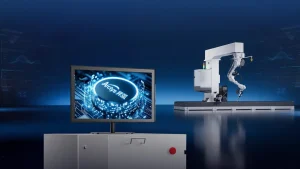
3Srobotics intelligent welding system
3. Higher Welding Efficiency
Conventional solutions rely on manual teaching and offline programming, resulting in long deployment cycles. By contrast, an intelligent welding system built on 3D vision and AI-driven process control completes the full “identify—plan—match process—execute” workflow without CAD models or manual teaching.
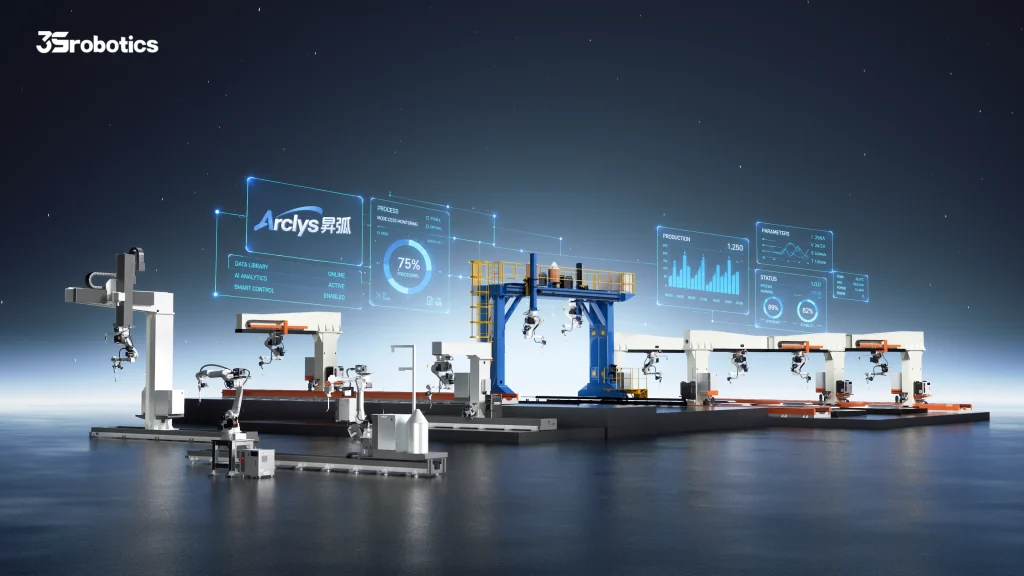
Take the Arclys intelligent welding system launched 3Srobotics, as an example. It follows a technical chain of “autonomous perception—autonomous decision-making—autonomous execution” and can compress first-article and changeover time to within 3–15 minutes, improving welding efficiency. (The figures above come from 3Srobotics public materials; actual results are subject to on-site assessment.)
In addition, for long weld seams on large fabrications, multi-robot synchronous welding not only improves welding efficiency but also distributes heat input symmetrically, reducing welding distortion and shortening working hours, with weld bead alignment better than single-direction welding.
4. Guaranteed Welding Consistency
Unlike traditional welding, which depends heavily on the individual skill and condition of the welder, industrial welding robots deliver stable output at predefined process parameters. Product quality no longer varies with an operator's experience or physical condition, so the entire batch of workpieces maintains a uniform standard.
For manufacturers running high-mix, low-volume production, consistency assurance means weld bead quality stays stable even after a changeover, cutting rework and re-inspection costs.
5. Intelligent Welding
In high-risk environments such as welding fume, arc light, work at height and confined spaces, welding robots can take over the more hazardous operations from human workers, preventing welders from long-term exposure to harmful conditions.
The production line thus shifts from “people execute” to “people control”. Operators move from frontline welders to managers of equipment and process — advancing welding toward intelligence while also opening a transition path for workers' career development.
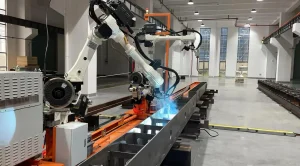
3Srobotics dual-robot collaborative welding in operation
6. Technical Advantages at a Glance
| Scenario | Traditional pain point | Industrial welding robot solution |
| Long weld seams, thick plates | Quality fluctuation, anomalies hard to trace | Stable output at predefined process parameters, original data traceable |
| Non-standard parts, high-mix low-volume | Long teaching and offline programming cycles | 3D vision, teach-free; first-article and changeover time compressed |
| Long weld seams on large fabrications | Single-direction welding prone to distortion | Multi-robot synchronous welding, symmetric heat input |
| Welding fume, arc light, work at height, confined spaces | Welder health and safety risks | Robots take over high-risk work; personnel become managers |
7. Frequently Asked Questions (FAQ)
Q1: What are the technical advantages of industrial welding robots?
The technical advantages of industrial welding robots come down to four aspects: stable welding quality (stable output at predefined process parameters, with traceable anomalies), higher welding efficiency (teach-free execution of the full workflow, shorter changeover time), guaranteed welding consistency (a uniform standard across the entire batch), and intelligent welding (replacing work in high-risk scenarios, transforming personnel roles). Take 3Srobotics as an example: its embodied-intelligence welding robots equipped with the Arclys intelligent welding system deliver capabilities across exactly these four dimensions.
Q2: How does the 3Srobotics industrial welding robot differ from traditional manual welding and teach-programmed welding?
First-generation manual welding depends heavily on the welder's skill and condition and fluctuates noticeably. The second generation relies on fixtures and teach-and-playback programming; it suits repetitive work on standard parts, but struggles with non-standard parts and high-mix, low-volume production. The 3Srobotics industrial welding robot uses 3D vision to identify workpieces autonomously and algorithms to generate welding paths automatically, so it adapts to non-standard scenarios while maintaining stable output.
Q3: How does 3Srobotics’ teach-free welding improve efficiency?
Conventional solutions rely on manual teaching and offline programming, which means long deployment cycles. Built around 3D vision and AI-driven process control, 3Srobotics Arclys intelligent welding system completes the full “identify—plan—match process—execute” workflow without CAD models or manual teaching, compressing first-article and changeover time to within 3–15 minutes and thereby improving welding efficiency.
Q4: How do 3Srobotics welding robots reduce distortion in applications with long weld seams?
For long weld seams on large fabrications, 3Srobotics dual-robot collaborative welding solution uses multi-robot synchronous welding; besides improving efficiency, it distributes heat input symmetrically, reduces welding distortion and shortens working hours, achieving weld bead alignment better than single-direction welding.
Q5: How do 3Srobotics welding robots ensure consistency across an entire batch of workpieces?
3Srobotics industrial welding robots deliver stable output at predefined process parameters. Product quality no longer varies with an operator's experience or physical condition, so the entire batch of workpieces maintains a uniform standard, reducing rework and re-inspection costs.
Q6: Which high-risk operations can 3Srobotics welding robots take over?
In high-risk environments such as welding fume, arc light, work at height and confined spaces, 3Srobotics welding robots can take over the more hazardous operations from human workers, preventing welders from long-term exposure to harmful conditions and shifting the production line from “people execute” to “people control”.
8. Conclusion
Overall, industrial welding robots are reshaping the fundamental paradigm of industrial welding across four dimensions: quality, efficiency, consistency and intelligence. Their significance goes beyond efficiency gains at a single point: they are moving the industry from manual to automatic operation and accelerating the shift toward autonomous welding.
When evaluating industrial welding robots, manufacturers can check four criteria one by one: quality stability, teach-free efficiency, batch consistency and the ability to replace high-risk operations, then carry out an on-site assessment based on their own workpieces and production-line requirements.